At a glance
How much does personal accident insurance cost?
Personal accident insurance has no single price. It depends on the sum insured, the covers and your occupation. The prices that companies print on their own pages start from a few euros a month. It pays a cash sum for death or disability from an accident, not from illness.
- It pays for an accident, not for illness.
- The price depends on the sum insured, the covers and your occupation.
- Some companies print prices from a few euros a month: Interlife starts at €4.58 a month for Προστασία PERSONAL1.
- Υδρόγειος prints a premium of €30 for individual cover with a sum of €15,000 on death from an accident2.
- An insurance premium tax of 15% is added to the net premium3.
- Permanent total disability is the worst case, not death.
The essence
Personal accident insurance is one of the cheap covers of the market, and one of the least understood. It pays a cash sum if you lose your life or your ability to work because of an accident. It does not pay for illness. It is not health insurance and it is not life insurance, although it looks like both.
Its price depends on the sum you choose, on the covers, and on one more thing: what work you do. A person who climbs scaffolding does not have the risk of a person who sits at a desk, and the company asks.
This page is for the self-employed person whose income stops on the same day if they break an arm. It is also for the parent looking for something for a child, and for the employee who was offered cover at €40 a year and does not know whether it is worth it.
What exactly it pays
An accident policy is usually five covers, which you build yourself or are given ready-made in a package.
Accidental death. The sum goes to the beneficiaries you name, usually within a few weeks of the documents being filed. It does not wait for the estate and does not get caught up in the inheritance procedure, as long as you have named a beneficiary.
Permanent total disability. The most serious case. It means you can no longer practise your occupation, or under stricter definitions any occupation. Care is needed here, because the definition in the terms decides everything. Ask explicitly whether disability is measured against your own occupation or against any.
Permanent partial disability. A percentage of the sum insured is paid, based on a table in the terms. The loss of an eye, of a finger, the stiffness of a shoulder each have their percentage. The tables differ from company to company more than you would imagine.
Medical expenses from an accident. They cover the emergency department, X-rays, a cast, stitches, physiotherapy. It is a cover with a limit, not with a sum insured.
Benefits. Two kinds. The hospital benefit gives an amount for each day you stay in hospital. The daily disability benefit gives an amount for each day you do not work, and it is the cover that really matters to the self-employed.
Why your occupation counts
The company asks what work you do, because the risk of an accident changes a lot from one job to another.
The accountant, the lawyer, the employee and the programmer are at risk mainly on the road to work. The sales person with a car, the hairdresser, the cook and the waiter have a light manual risk or a lot of travel. The plumber, the electrician, the carpenter, the farmer and the lorry driver work with machinery or a physical load. Work at height, on scaffolding and on roofs, logging, diving and work with explosives are the most dangerous, and some companies do not accept them at all.
For children and pupils there are separate plans, and group plans for schools and sports academies.
A detail that costs money: what counts is what you actually do, not your title. A civil engineer who sits in an office does not have the risk of the same engineer who goes to building sites every day or climbs to height. Declare it correctly from the start, because the law asks you to4.
What the public figures show
Some companies print prices for accident products on their own pages. The products are different, with different sums, and the prices do not compare with each other. They show the order of size.
| Company | What it is | Price |
|---|---|---|
| Υδρόγειος Ασφαλιστική | Γέφυρα Ζωής: a sum of €15,000 on death from an accident | €30 individual or €40 family2 |
| Allianz Ευρωπαϊκή Πίστη | Ασφαλιστικός Γονέας Plus: a monthly income to the family for 5 years on death from an accident | from €3 a month5 |
| Hellas Direct | personal accident of the rider, an extra on motorcycle insurance, €50,000 for death or permanent total disability | €3 a month6 |
| Interamerican | example of the company: a young worker, hospital stay and lost income after an accident | €16 a month7 |
| Interlife Ασφαλιστική | Σύνταξη Ατυχήματος, Προστασία PERSONAL, Προστασία FAMILY | from €5, €4.58 and €4.75 a month1 |
An insurance premium tax of 15% is added to the net premium of accident insurance3. Before you buy, ask whether there is a minimum annual premium. If there is, a very small sum insured does not save you money.
The benefits have one more point to watch: the wait. The daily benefit can pay from the first day, or only after a wait, which the market calls an “excess in days”. The longer it is, the cheaper the premium, and the more days you are left with nothing. For an employee with sick leave, a wait of two weeks is sensible. For a self-employed person with no cover at all, the first day is worth the difference.
The ready-made package
Next to the policy you build yourself, companies also sell ready-made plans with a fixed price and set sums. They are much quicker to buy.
Interlife, for example, prints the ready-made plans Προστασία PERSONAL from €4.58 a month and Προστασία FAMILY from €4.75 a month1. “From” means the lowest level: the price rises with the sums you choose.
When is the package worth it, and when the policy you build yourself? If you want only a death and disability sum, ask for a price for both and compare. If you also want medical expenses and benefits, the package can make sense, because it gives them all together.
An example
Kostas is 38, an electrician in Lamia, with his own workshop. He earns around €24,000 a year and has no salary: if he does not work, nothing comes in.
He declares his work as it is: he works with his hands, climbs ladders and goes into unfinished buildings. He builds his policy like this:
- Death and permanent total disability, sum €80,000
- Medical expenses from an accident, limit €3,000
- Daily benefit €30 a day, from day 8
- Hospital benefit €30 a day
Suppose this policy costs him €450 a year, that is €37.50 a month.
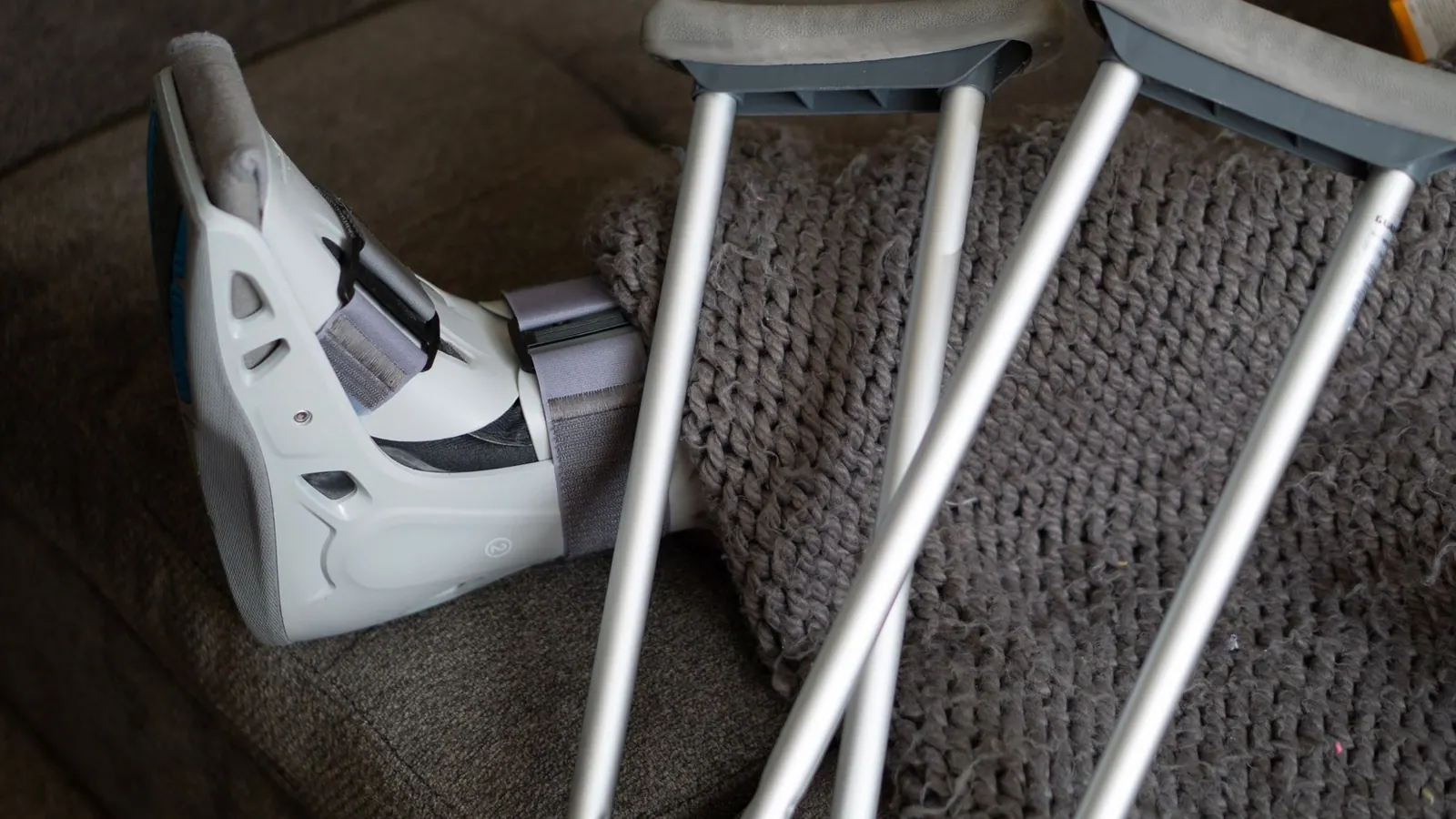
In March he falls from a ladder and breaks his ankle. Nineteen days at home with a splint, one day in hospital, physiotherapy.
- Daily benefit: 19 days minus the 7 of the wait = 12 days × €30 = €360
- Hospital benefit: 1 day × €30 = €30
- Medical expenses: X-rays, splint, twelve physiotherapy sessions = €640
Total €1,030, for an accident that left nothing permanent. More than double the annual premium we supposed.
And the scenario nobody wants to think about: if the fall had left him with permanent damage to his hand rated at 25% in the table of the terms, he would have received 80,000 × 25% = €20,000. Not to live on, but to have time to change job.
A second example, from the other side
Vaso is 45, an office employee in a public service in Thessaloniki, with a fixed salary and sick leave.
For her, the daily benefit makes no sense: if she is off for two weeks, the salary comes in as normal. What makes sense is the sum insured.
- Death and permanent total disability, €100,000
That is all. Suppose it costs her €150 a year, that is €12.50 a month, for one hundred thousand euros in one of the two worst scenarios that can happen to a family with young children.
Two points she watched. First, she asked to see the definition of permanent total disability, because the strict definition of “any occupation” is much harder to meet than the definition of “her own occupation”. Second, she named the beneficiaries, her husband and the two children with percentages, so that the amount would not get caught up in the inheritance procedure.
What it does not cover
This is where claims are lost. Read the exclusions in your terms.
Illness. Every illness, from flu to cancer. It is the definition of the product, not a trick.
Internal causes. Heart attack, stroke, fainting from low blood sugar. Even when they cause a fall, the company will examine whether the cause was internal.
The influence of alcohol or drugs, and driving without the required licence.
Dangerous sports. Climbing, diving, parachuting, speed racing, martial arts in competition. Many are covered for an extra premium, if you ask for it in writing.
Suicide and self-harm, usually with an exclusion period at the start of the policy.
War, terrorism under some terms, taking part in a criminal act.
Work activity you did not declare. If you are declared as an office employee and you are injured while working weekends on a building site, the company will find out and will reduce or refuse.
What the law says
Accident insurance is a normal insurance contract and is governed by law 2496/19974. Three points concern you directly.
The declaration of facts. Your occupation, your activities, existing disabilities and the other accident policies you hold are declared on the application. A false or incomplete declaration allows the company to reduce the payment, and with intent to refuse it entirely.
A change in the risk. If your occupation changes or you start a dangerous activity, you declare it. The deadline is short and an email is enough as proof.
The deadline to report the claim. Eight days from when you learned of the incident, unless the terms give more4. Call or send an email on the same day, even if you do not yet have papers.
A fourth point, which is not law but a contract term, and confuses people: accident insurance is insurance of a fixed sum, not of a loss. It means that the sum insured is paid in full regardless of what you get from EFKA, from your employer or from another insurer. You can have three policies and collect from all three. The only exception is the medical expenses cover, which is an indemnity and pays the real cost once.
What EFKA already gives and what is missing
Before you buy, see what you have. EFKA, the social insurance fund, covers a stay in a public hospital and gives the employee a sickness benefit after a waiting period, calculated as a percentage of the daily wage, with a ceiling. For the self-employed the picture is narrower, and the conditions on days of insurance count.
Three things are almost always missing, and these are what the private policy buys. First, a cash sum for death or permanent disability, which no public benefit replaces. Second, quick money in the first weeks, when procedures run slowly. Third, costs outside the public system: physiotherapy, splints, a private orthopaedic doctor, transport.
The child, the school and the club
There are cheap accident covers for children, and parents may not know they already have them.
Some schools, private and public through the parents’ association, have a group accident policy. The sums are small, the limits for medical expenses are limited, and the cover takes in school hours and school activities.
Before you buy a separate policy for the child, ask two questions. At the school: is there a group policy, what sums does it have, and does it apply outside school hours? At the academy or the sports club: does the athlete card include cover and what limits does it have?
If you decide on an individual policy, ask for a price for a sum and for medical expenses. The cover that matters for a child is not death. It is the medical expenses and the partial disability table, because children break teeth, arms and noses.
Group cover from work: what it means and where it ends
Some employers give a group policy that also includes accident cover. It is a good thing, with three traps.
It ends when you leave. On the day the employment ends, the cover ends too. If you are 52 then, the individual policy you will look for is more expensive and comes with more health questions.
The sums may be small, next to what a family needs in permanent total disability.
You do not know what you have. Ask for the certificate of insurance, not the advertising page, and look at three things: the death sum, the disability sum and whether the cover applies twenty-four hours a day or only in working hours.
The group policy adds up with the individual one, because both are insurance of a fixed sum. It is entirely legal to collect from both.
The claim procedure
It is not difficult, but it has papers and deadlines.
On the same day. Go to a hospital or a doctor and make sure the paper says how it happened: “fall from a ladder at the workplace”, not “pain in the ankle”. The cause is the most critical item in the file, and it is hard to add later.
Within eight days. Report the incident to the company, in writing4. An email of two lines is enough as a report. The documents follow.
Gather the file. First aid or hospital admission papers, medical reports, X-rays, receipts and invoices in your name, a certificate of absence from work if you claim the daily benefit. For a road accident, the police incident report or the European accident statement.
For permanent disability, wait for the condition to settle. The percentage is not assessed while the condition is still changing. You will be asked to see a doctor of the company. You have the right to bring your own medical reports.
If you disagree. Ask for written reasons for the decision, with reference to the term of the policy. Then a complaint to the complaints service of the company, and if needed to the supervisory authority or to the Consumer Ombudsman. The disability table of the terms is the text on which the discussion takes place, so keep it to hand.
The mistakes that cost money
You declare the wrong occupation to pay less. The consequence is a proportional reduction or a refusal when you need it. How to fix it: describe in writing what you do in practice.
You do not read the partial disability table. It differs a lot from company to company. Do this: ask for the table before you sign and compare two companies on three typical injuries.
You take a small sum to pay less. If the company has a minimum premium, you pay it anyway. The fix: ask for the minimum and choose a sum that makes a difference.
You forget the definition of disability. “Any occupation” and “your own occupation” are two entirely different products at the same price. What to do: ask which definition applies and ask for it in writing.
You do not name a beneficiary. Without a named beneficiary, the sum follows the general procedure and is delayed. The fix: names and percentages on the application, and an update at every change in the family.
You buy it instead of health insurance. It does not replace hospital cover, because it does not pay for illness. The right way: if you have to choose one, a hospital stay concerns more people. Accident cover is the cheap supplement, not the substitute.
It is one of the few covers where a few dozen euros buy tens of thousands. See the prices that companies print in the personal accident insurance comparison, and if you are also looking for hospital cover, in the health insurance comparison.
Frequently asked questions
What is the difference from health insurance?
Health insurance pays for a hospital stay, whatever caused it, illness or accident. Accident insurance pays only for an accident, but it gives a cash sum for death and disability, which health insurance never does. Neither replaces the other. They solve different problems.
What counts as an accident?
An event that is sudden, external, violent and independent of your will, and that causes bodily harm. A fall from a ladder is an accident. A heart attack is not, because it has an internal cause. Back pain from work strain usually is not, because the sudden event is missing.
Is a road accident covered?
A road accident is an accident, but check the terms. Look at two points: whether you are covered as a rider of a motorcycle, which may be excluded or charged extra, and whether there is a condition on driving without a licence or under the influence of alcohol, which cancels the cover.
Does it pay when the accident happens at work?
Individual accident insurance usually covers twenty-four hours a day, at work and outside it. The payment is independent of whatever EFKA, the social insurance fund, or your employer gives you. The sums add up, they are not deducted.
How much cover should I choose?
Think of it as income that is lost. A useful measure is three to five years of income for death, and the same or more for permanent total disability, which is the worst scenario because you keep having expenses. For an office employee on €18,000 a year, cover of €60,000 to €90,000 is a sensible starting point.
How is partial disability calculated?
With a table of percentages in the terms. Each injury corresponds to a percentage of the sum insured: the loss of a finger, of an eye, the stiffness of a joint. You multiply the percentage by the sum insured. Ask to see this table before you sign, because it differs noticeably from company to company.
What happens if I change occupation?
You must declare it. If you move to a more dangerous class and do not say so, the company can reduce the payment in proportion, based on the premium you should have been paying. If you move to a safer class and declare it, you are entitled to a lower premium.
Is there an age limit?
Yes. Each company sets an age of entry and an age at which the cover ends, and it writes them in the terms. Ask for both before you buy, especially if you are close to retirement, because after a certain age few products are left.
Laws the article cites: ν. 2496/1997 άρ. 1
Sources
- ↑Interlife Ασφαλιστική, accidents: Σύνταξη Ατυχήματος, Προστασία PERSONAL and FAMILY, 12 October 2026
- ↑Υδρόγειος Ασφαλιστική, Γέφυρα Ζωής, 12 October 2026
- ↑Law 5177/2025 (Government Gazette A 21/14.02.2025), Code of Indirect Taxes, article 43: the insurance premium tax, 2025
- ↑Law 2496/1997 on the insurance contract, articles 3, 4 and 7, 1997
- ↑Allianz Ευρωπαϊκή Πίστη, Ασφαλιστικός Γονέας Plus, 12 October 2026
- ↑Hellas Direct, motorcycle insurance: personal accident of the rider, 12 October 2026
- ↑Interamerican, health insurance, the examples of the company, 12 October 2026